
Optomechanics with feedback loops
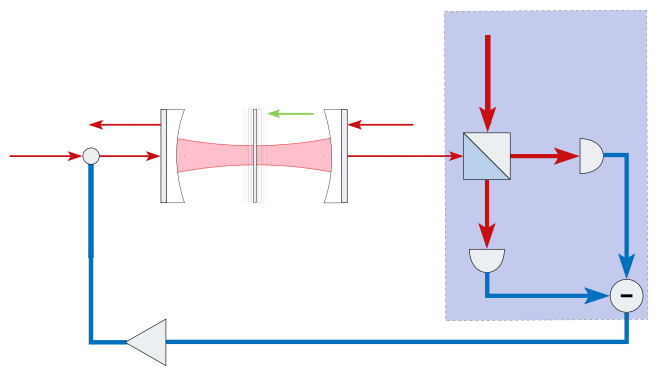
Feedback control uses information about the current state of a system to steer it to some predefined final state. In quantum physics, two distinct types of feedback are possible—measurement-based and coherent. The former uses a measurement to obtain partial information about the system followed by an operation conditioned on the measurement outcome; in the latter, the output is directly fed back using a quantum channel without the need for measurement. We investigated strategies for using both measurement-based and coherent feedback to control optomechanical devices with the goal of improving their sensitivity to external forces and reducing their noise.
Key publication
Foroud Bemani, Ondřej Černotík, Angelo Manetta, Ulrich Hoff, Ulrik Andersen, and Radim Filip, Optical and mechanical squeezing with coherent feedback control beyond the resolved-sideband regime, Physical Review Applied 22, 044028 (2024).
Optomechanical levitation with coherent scattering
The main limitation of optomechanical systems are mechanical losses. Mechanical resonators are clamped to substrates which destroys their fragile quantum states. A solution to this problem is to trap the mechanical resonator (a small particle) using light, which confines its motion to a narrow region around the intensity maximum. The motion can then be precisely controlled by scattering the trapping light into an optical cavity. I study how these techniques can be used to control the motion of one or more particles in one cavity.

Key publications
Anil Kumar Chauhan, Ondřej Černotík, and Radim Filip, Tuneable Gaussian entanglement in levitated nanoparticle arrays, npj Quantum Information 8, 151 (2022).
Ondřej Černotík and Radim Filip, Strong mechanical squeezing for a levitated particle by coherent scattering, Physical Review Research 2, 013052 (2020).
Cavity optomechanics with hybrid mirrors
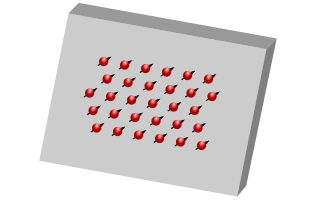
I analysed hybrid optomechanical systems formed by dielectric membranes doped with two-level quantum emitters or patterned with photonic crystal structures. Such hybrid mirrors strongly reflect light around a particular wavelength, leading to a modified response to light. My goal was to find out what interesting applications such devices might have. Some existing optomechanical experiments—such as optomechanical cooling—can be improved with this approach.
Key publication
Ondřej Černotík, Aurélien Dantan, and Claudiu Genes, Cavity quantum electrodynamics with frequency-dependent reflectors, Physical Review Letters 122, 243601 (2019).
Optomechanical transduction
Mechanical oscillators can couple to a broad range of external forces and are thus suitable for conversion of signals between different carriers. One particular—and important—example is the conversion between microwaves and light which can be used improve detection of weak microwave signals or for conversion of quantum signals between superconducting quantum computers (operating at microwave frequencies) and light (suitable for long-distance quantum communication).

Key publications
Ondřej Černotík, Sahand Mahmoodian, and Klemens Hammerer, Spatially adiabatic frequency conversion in optoelectromechanical arrays, Physical Review Letters 121, 110506 (2018).
Ondřej Černotík and Klemens Hammerer, Measurement-induced long-distance entanglement of superconducting qubits using optomechanical transducers, Physical Review A 94, 012340 (2016).
Gaussian entanglement of light
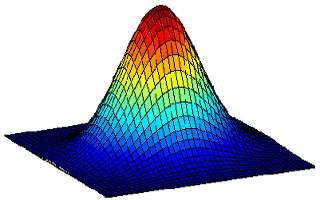
Gaussian states of light are an important subclass of all quantum states of light owing to their easy creation and manipulation. Most importantly, entangled Gaussian states can be prepared deterministically, unlike entangled states based on single photons. An important topic of research is finding states best suited for a specific task (such as quantum teleportation) or developing efficient protocols involving non-Gaussian operations (which are necessary, for instance, for entanglement concentration and distillation).
Key publication
Ondřej Černotík and Jaromír Fiurášek, Displacement-enhanced continuous-variable entanglement concentration, Physical Review A 86, 052339 (2012).
 Ondřej Černotík